
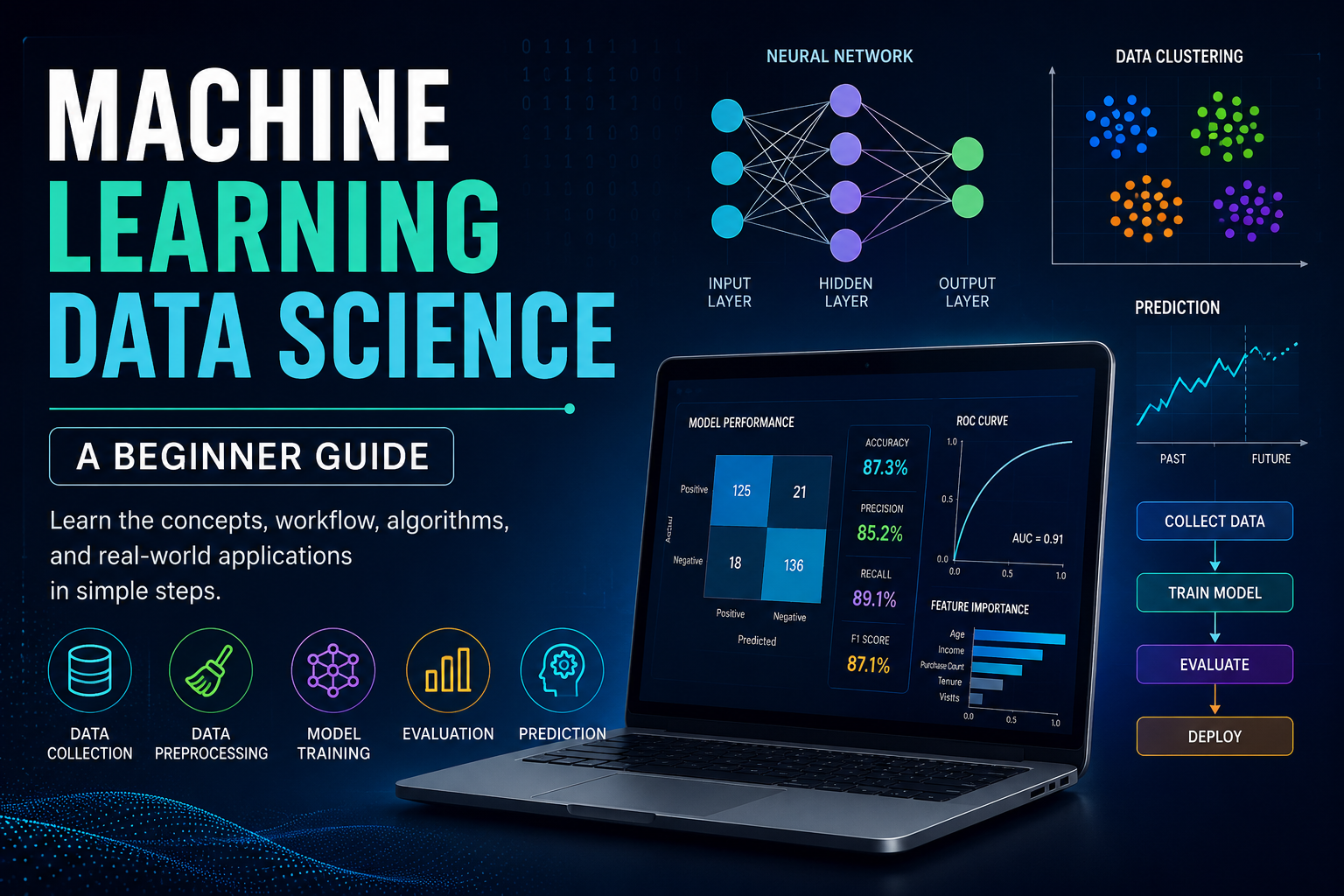
Machine learning data science helps businesses and analysts turn data into useful predictions and practical decisions. Today, many organizations use machine learning data science to improve business planning, automate repetitive tasks, and identify patterns faster than manual analysis. Instead of reviewing every record one by one, machine learning allows systems to learn from historical data and recognize patterns automatically. As a result, teams can save time, improve efficiency, and make decisions with stronger confidence.
The growth of data science has changed how businesses operate. Marketing teams use data to understand customer behavior and campaign performance. Finance teams rely on predictive models to forecast results and detect unusual activity. Meanwhile, healthcare teams use machine learning to support diagnosis and risk prediction.
For beginners, machine learning can feel overwhelming at first. There are many terms, tools, and examples online. Because of that, many people feel unsure about where to start. The good news is that machine learning becomes easier when you understand the basic workflow clearly.
This guide explains machine learning data science in simple terms. It also covers the main concepts, the beginner workflow, practical use cases, and the steps most people follow when starting their first machine learning project.
What Is Machine Learning Data Science?
Machine learning data science combines data analysis, statistics, and algorithms to help systems learn patterns from data.
The main goal is simple.
A machine reviews historical information.
Then it learns patterns from that information.
After that, it uses those patterns to estimate future outcomes or recommend actions.
Unlike traditional reports, machine learning does more than describe what already happened. It also helps predict what may happen next.
For example, businesses can use machine learning for:
- Predicting customer churn
- Forecasting future sales
- Recommending products
- Detecting fraud
- Identifying risky trends
- Understanding customer segments
That makes machine learning valuable because it supports faster and more informed decisions.
Instead of relying only on experience or assumptions, teams can use real data patterns to support planning.
Why Machine Learning Matters in Data Science
Traditional data analysis often explains past performance.
Machine learning adds a predictive layer.
That difference creates stronger opportunities.
For example, a sales report may show which products performed well last month. Machine learning can analyze the same historical pattern and estimate which products are likely to perform best next month.
A marketing dashboard may show campaign performance.
Machine learning can help predict which audience is more likely to convert.
Because of that, businesses can act earlier and make more targeted decisions.
Machine learning helps organizations:
- Find hidden patterns
- Forecast future outcomes
- Improve customer targeting
- Reduce manual work
- Support faster planning
- Improve operational efficiency
In addition, machine learning helps teams focus attention where it matters most.
That creates practical business value.
Core Concepts Beginners Should Know
Before starting, it helps to understand several common terms.
These concepts appear in almost every machine learning project.
Dataset
A dataset is a collection of information used for analysis.
Examples include:
- Customer records
- Website traffic
- Sales reports
- Product inventory
- Marketing campaigns
- Healthcare data
A dataset usually contains rows and columns.
Rows represent records.
Columns represent variables.
For example:
A customer dataset may contain:
- Name
- Age
- Purchase count
- Product category
- Last transaction date
This becomes the foundation for analysis and training.
Features
Features are the input values used by the model.
Examples:
- Age
- Purchase amount
- Website visits
- Email open rate
- Product type
The machine studies these values.
Then it looks for patterns between them.
The quality of these features often affects results.
Relevant features usually improve predictions.
Target
The target is the final outcome the model predicts.
Examples include:
- Will the customer buy again?
- Will revenue increase?
- Is this transaction unusual?
- Which campaign will perform best?
The machine uses available features to estimate the target.
Model
A model is the system trained to recognize patterns.
Once training is complete, the model can estimate future outcomes.
Different projects may use different models.
However, beginners do not need to understand every option immediately.
The important part is understanding the workflow.
Training
Training is the process of teaching the model.
The system reviews historical data.
Then it learns relationships between inputs and outcomes.
The more relevant and organized the data is, the easier this becomes.
Types of Machine Learning
There are several machine learning categories.
Beginners usually start with three.
1. Supervised Learning
The machine learns using labeled data.
That means the correct answer already exists.
Examples:
- Customer churn
- Spam detection
- Sales forecasting
The model studies past examples.
Then predicts future results.
This is usually the easiest place for beginners to begin.
2. Unsupervised Learning
No labels are provided.
The machine looks for patterns on its own.
Examples:
- Customer segmentation
- Grouping similar products
- Finding hidden patterns
This is useful when you want to understand structure inside the data.
3. Reinforcement Learning
The machine learns through feedback.
It tests actions.
Then improves over time.
Examples include:
- Robotics
- Recommendation systems
- Advanced automation
For beginners, supervised learning is often the most practical first step.
Machine Learning Workflow for Beginners
A simple workflow makes the process easier.
Most beginner projects follow similar steps.
1. Collect Data
Start by gathering useful information.
Examples:
- Excel spreadsheets
- Databases
- CRM exports
- Website analytics
- Business reports
The key is relevance.
Use information connected to the business goal.
For example:
If the goal is predicting repeat customers, useful fields may include:
- Purchase count
- Visit history
- Spending amount
Starting with relevant data makes later steps easier.
2. Clean the Data
Raw data usually needs adjustment.
Common issues include:
- Missing values
- Duplicate rows
- Incorrect formatting
- Empty cells
- Inconsistent labels
Cleaning improves reliability.
For example:
“Premium” and “premium” should be standardized.
Likewise, missing values should be reviewed before analysis.
This step often takes time.
However, it improves everything later.
3. Explore the Data
Before training, review the dataset.
Look for patterns.
Check for unusual values.
Understand how columns relate.
Useful questions:
- Which variables appear important?
- Are there obvious trends?
- Are some categories larger?
- Is there missing information?
This step helps you understand the data better.
It also helps avoid mistakes later.
If you want practical examples, you can explore projects at kenchristn.com.
4. Train the Model
Once the dataset is ready, choose a model.
Then train it.
The machine reviews historical data.
It learns patterns.
Then it starts estimating future outcomes.
This is where machine learning begins creating practical value.
5. Review Results
After training, review the output.
Ask:
- Are predictions useful?
- Do results match expectations?
- Are there patterns worth exploring?
- Is the model helping answer the goal?
Beginners do not need perfect accuracy.
The goal is learning how the workflow works.
Then improving over time.
6. Apply Insights
This is the business value stage.
Use the output to improve decisions.
Examples:
- Forecast demand
- Improve marketing
- Prioritize leads
- Adjust planning
- Support operations
This turns analysis into action.
That is where machine learning becomes practical.
Real Business Applications
Machine learning supports many industries.
Examples include:
Marketing
Marketing teams often use machine learning to:
- Predict campaign performance
- Recommend products
- Segment audiences
- Improve targeting
This helps campaigns become more efficient.
Sales
Sales teams may use machine learning to:
- Forecast revenue
- Prioritize leads
- Predict churn
- Estimate demand
That improves planning and sales focus.
Finance
Finance teams often use machine learning for:
- Fraud detection
- Forecasting
- Budget analysis
This improves speed and accuracy.
Operations
Operations teams use machine learning for:
- Demand planning
- Resource allocation
- Process optimization
That improves efficiency.
Healthcare
Healthcare teams use machine learning to:
- Predict risk
- Review patient patterns
- Support diagnosis
A practical example is available in my project on Heart Disease Prediction Using Machine Learning, where structured medical data is transformed into predictive insights.
Tools Beginners Can Use
You do not need advanced systems.
A practical setup is enough.
Common tools include:
These tools are beginner-friendly and commonly used in real projects.
Start simple.
Then improve gradually.
Common Beginner Mistakes
Many beginners move too quickly.
Common mistakes include:
- Using messy data
- Skipping exploration
- Training too early
- Tracking too many variables
- Expecting perfect predictions
- Trying too many tools at once
Instead, focus on the workflow.
Practice one step at a time.
That usually creates stronger learning.
Final Thoughts
Machine learning data science helps businesses use data more effectively.
It turns historical information into practical predictions.
It improves decision-making.
It helps teams work faster.
Most importantly, beginners do not need advanced systems to begin.
A simple workflow is enough:
- collect data
- clean data
- explore patterns
- train the model
- review results
- apply insights
Start small.
Practice consistently.
Then improve with each project.
Over time, machine learning becomes easier to understand and more valuable for real business decisions.
Need Help With Machine Learning or Data Science?
If you are working with datasets, dashboards, machine learning, or business analytics, I’d be happy to help.
Visit kenchristn.com to explore my portfolio and recent projects in data analysis, dashboards, and AI automation.
You can reach out for help with:
- Machine learning projects
- Data science workflows
- Dataset cleaning and analysis
- KPI dashboards and reporting
- SQL and data processing
- Turning raw data into practical business insights
Let’s turn your data into useful insights and smarter decisions.