
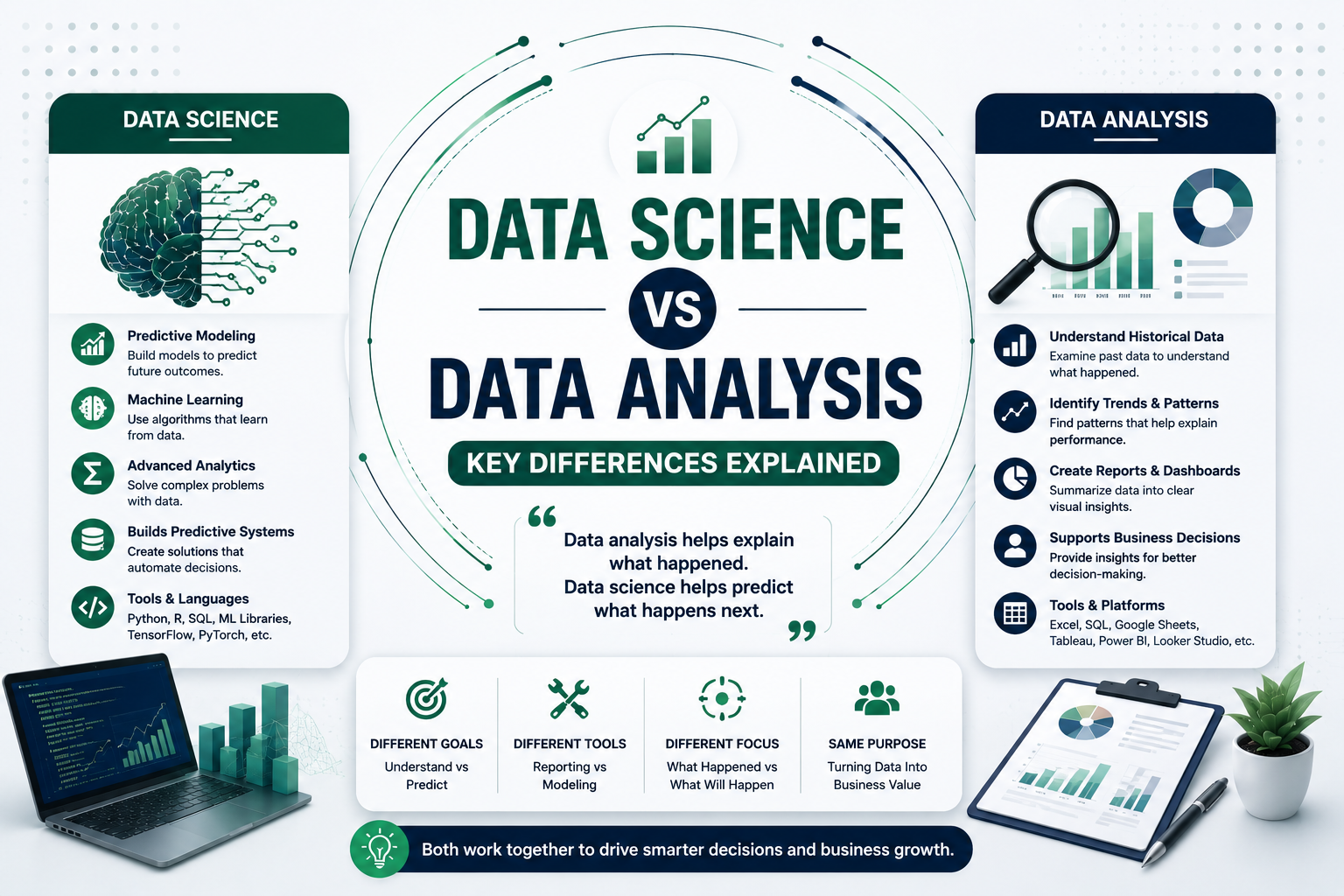
As businesses continue becoming more data-driven, terms like data science and data analysis appear more frequently in conversations about technology, business growth, and decision-making. Many people use the two interchangeably because both involve working with data. While they are closely related, they are not exactly the same.
Understanding the difference between data science and data analysis matters for businesses, teams, and anyone learning data skills. Both fields help organizations understand information and make better decisions, but they focus on different goals and solve different types of problems.
“Data analysis helps explain what happened. Data science helps predict what happens next.”
That simple difference explains why both fields are important and why many companies use them together.
What Is Data Analysis?
Data analysis is the process of collecting, cleaning, organizing, and interpreting data to discover useful insights.
The main goal is to answer practical business questions using historical or current data. Analysts turn raw numbers into understandable reports and dashboards that support decision-making.
For example, a sales team may review monthly transactions and identify which products generated the highest revenue or which region performed best.
Common outputs from data analysis include:
- Dashboards and KPI reports
- Sales performance summaries
- Customer behavior insights
- Marketing campaign reports
- Operational recommendations
The focus is understanding performance clearly and helping teams make decisions faster.
What Is Data Science?
Data science is a broader field that combines data analysis, programming, statistics, and machine learning.
While data analysis focuses on understanding data, data science often focuses on prediction and advanced modeling.
For example, an e-commerce business may use data science to predict:
- Which customers are likely to purchase again
- Which products may trend next month
- Which users may stop using the platform
- Which recommendation is most likely to convert
Instead of only reviewing what happened, data science helps businesses prepare for future outcomes.
Think of it this way:
A data analyst builds the dashboard.
A data scientist builds the model behind future predictions.
Data Science vs Data Analysis: Quick Comparison
Here’s a simple side-by-side comparison:
| Category | Data Analysis | Data Science |
|---|---|---|
| Main Goal | Understand current & past performance | Predict future outcomes |
| Focus | Reporting & insights | Modeling & prediction |
| Common Questions | What happened? Why? | What will happen next? |
| Tools | Excel, SQL, dashboards | Python, ML libraries |
| Output | Reports, charts, KPIs | Predictive models |
| Technical Complexity | Moderate | Higher |
| Business Use | Daily decisions | Forecasting & automation |
This comparison makes it easier to see where each role fits.
Real-World Example: E-Commerce Business
Imagine an online store selling electronics and accessories.
A data analyst may review the last three months of sales and discover:
- Weekend sales are consistently higher
- Accessories have higher repeat purchases
- One product category has lower performance
The analyst builds dashboards and recommends focusing promotions on high-performing categories.
A data scientist can use the same data differently.
They may build a predictive model to estimate:
- Next month’s product demand
- Which customers may return soon
- Which product recommendations increase conversions
Both teams use data—but solve different business needs.
Real-World Example: Digital Marketing
A marketing team also benefits from both roles.
A data analyst reviews campaign performance:
- Website traffic
- Conversion rate
- Cost per click
- Customer acquisition cost
The goal is understanding which campaigns perform best.
A data scientist may then build a model to predict:
- Which audience is most likely to convert
- Which ad timing works best
- Which campaign may perform strongest next month
That creates smarter targeting and more efficient budget decisions.
Skills Needed in Data Analysis
Data analysis focuses on business understanding and communicating insights clearly.
Core skills often include:
✔ Data cleaning
✔ Spreadsheet management
✔ SQL queries
✔ Dashboard creation
✔ KPI tracking
✔ Reporting and visualization
Soft skills also matter.
A strong analyst can explain complex numbers in simple language so teams can act quickly.
Skills Needed in Data Science
Data science usually requires more technical depth.
Common skills include:
✔ Python programming
✔ Statistics and probability
✔ Machine learning
✔ Predictive modeling
✔ Data engineering basics
✔ Handling larger datasets
Because the work is more technical, data scientists often spend more time experimenting and validating models.
When Businesses Need Data Analysis
Data analysis is often the best fit when teams need fast visibility into business performance.
Examples include:
Sales Dashboard
Track:
- Revenue trends
- Best-selling products
- Regional performance
Marketing Performance
Track:
- Campaign ROI
- Website traffic
- Lead generation
Operations
Track:
- Delivery time
- Productivity
- Workflow bottlenecks
These insights support immediate business decisions.
When Businesses Need Data Science
Data science becomes valuable when businesses need prediction or advanced automation.
Examples include:
Demand Forecasting
Predict future inventory needs.
Customer Churn Prediction
Identify customers likely to leave.
Product Recommendation Systems
Recommend products automatically.
Fraud Detection
Spot unusual activity faster.
These use cases often create stronger long-term efficiency.
Which One Should You Learn First?
For beginners, data analysis is usually the most practical starting point.
Why?
Because it builds strong foundations:
- Understanding data structure
- Cleaning messy datasets
- Working with SQL
- Building dashboards
- Communicating insights clearly
Once those skills feel comfortable, moving into data science becomes easier.
A common learning path looks like this:
Excel → SQL → Dashboards → Python → Statistics → Machine Learning
That path also works well for building portfolio projects.
Tip for beginners:
Start with real business datasets and focus on solving practical problems first. The technical side becomes easier when tied to real use cases.
Key Takeaways
Before choosing between data analysis and data science, remember:
✅ Data analysis explains current and historical performance
✅ Data science predicts future outcomes
✅ Data analysis supports reporting and KPIs
✅ Data science supports machine learning and forecasting
✅ Businesses often use both together
The two are connected, and both create strong business value.
Final Thoughts
Data science and data analysis are closely related, but they serve different purposes.
Data analysis helps businesses understand performance, monitor KPIs, and make informed decisions based on current or historical data.
Data science builds on those insights using programming, statistics, and machine learning to predict outcomes and automate more advanced decisions.
Neither replaces the other.
In many businesses, both work together:
- Analysts help teams understand what is happening
- Data scientists help businesses prepare for what happens next
As companies continue becoming more data-driven, understanding both fields becomes increasingly valuable.
Need Help Turning Data Into Insights?
Whether you’re organizing business data, building dashboards, or exploring smarter ways to work with data, I’d be happy to help.
Visit kenchristn.com to explore my portfolio and recent projects in data analysis, dashboards, and AI automation.
You can reach out for help with:
- Data cleaning and preparation
- Dashboard creation and KPI reporting
- SQL analysis
- Business data visualization
- Workflow automation with AI tools
- Turning raw data into actionable insights
Let’s turn your data into clear insights that support smarter business decisions.