
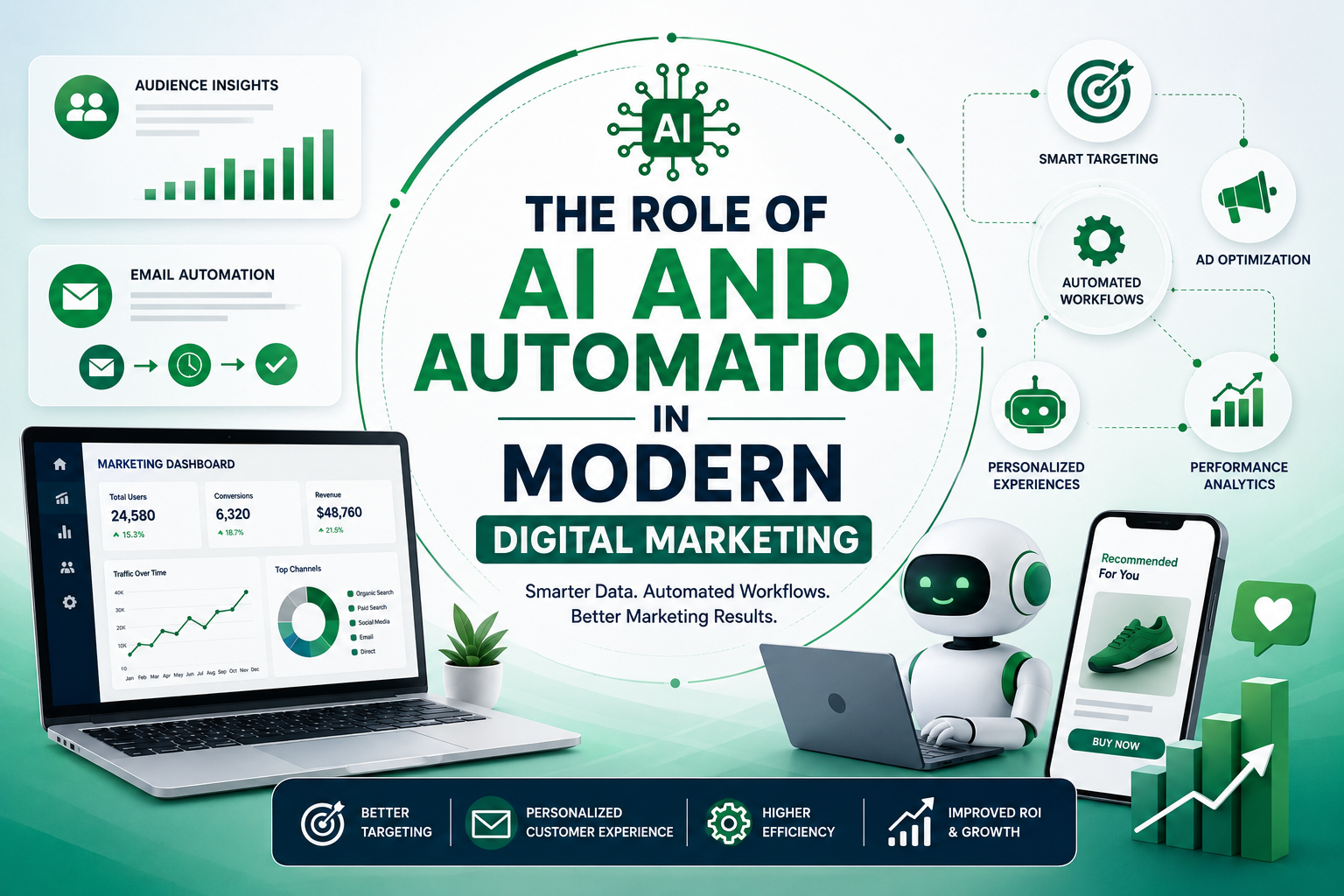
Digital marketing continues to evolve faster than ever. Businesses are no longer relying only on traditional advertising or manual campaign management to reach customers online. With increasing competition and changing customer behavior, brands need smarter ways to market effectively and respond faster.
This is why AI and automation have become important in modern digital marketing. Artificial intelligence helps businesses analyze customer behavior, understand trends, and make smarter decisions. Automation helps execute repetitive tasks faster and more consistently. Together, they allow marketing teams to improve performance while saving time.
What once required hours of manual work can now be handled more efficiently through AI-powered tools and automated workflows. From email campaigns to customer segmentation and ad optimization, businesses of all sizes are using AI and automation to improve marketing results.
As digital marketing becomes more data-driven, companies that use both effectively are often better positioned to reach the right audience, improve customer engagement, and scale their campaigns with more confidence.
Understanding AI and Automation in Digital Marketing
AI in digital marketing refers to the use of artificial intelligence to analyze data, recognize patterns, and support decision-making. It helps marketers understand customer behavior more clearly and improve campaign performance based on real-time insights.
Automation focuses on completing repetitive tasks automatically. This can include scheduling emails, posting social media content, updating reports, or triggering customer follow-ups.
When AI and automation work together, businesses can both understand customer behavior and act on that information faster.
For example, an online store may analyze browsing behavior using AI. Based on that behavior, automation can instantly send a personalized email or show a relevant product recommendation.
This creates a faster and more personalized marketing workflow.
Why AI and Automation Matter in Modern Digital Marketing
Modern customers interact with brands across multiple channels. They may discover a product through social media, visit the website later, subscribe to email, and make a purchase days after.
Managing all of those interactions manually can quickly become difficult.
AI and automation help businesses handle large amounts of data and customer activity more efficiently.
Some of the biggest reasons businesses use them today include:
- Faster campaign execution
- Better customer targeting
- More personalized communication
- Improved performance tracking
- Reduced repetitive manual work
- Better scalability as marketing grows
This helps teams focus more on strategy and creative work instead of repetitive operational tasks.
AI-Powered Customer Segmentation
One of the most valuable roles of AI in digital marketing is customer segmentation.
Traditional segmentation often groups audiences manually based on age, location, or broad demographics. AI can go much deeper by identifying patterns based on browsing behavior, purchase history, engagement activity, and customer preferences.
For example, an e-commerce business may use AI to recognize that a group of customers often purchases fitness-related products after reading blog content about health.
The marketing team can then create targeted campaigns specifically for that audience.
AI-driven segmentation helps businesses:
- Deliver more relevant offers
- Improve ad targeting
- Increase conversion rates
- Reduce wasted marketing spend
This creates more efficient campaigns because customers receive messages based on actual behavior.
Personalized Marketing at Scale
Personalization has become one of the strongest factors in digital marketing.
Customers expect relevant recommendations and timely communication. AI helps businesses personalize experiences even when managing large audiences.
A familiar example is Amazon. The platform uses AI to recommend products based on previous browsing and buying behavior.
A smaller business can apply the same concept.
For example:
A customer visits an online store and views running shoes multiple times but does not buy. AI recognizes interest in that product category. Automation then sends a reminder email with related recommendations or a limited-time offer.
This type of personalization often improves:
- Click-through rates
- Email engagement
- Customer retention
- Conversion rates
The experience feels more relevant without requiring manual work from the team.
Automating Email Marketing Campaigns
Email marketing remains one of the strongest digital marketing channels.
AI and automation make email marketing much more effective.
Instead of manually sending campaigns one by one, businesses can automate customer journeys.
Examples include:
- Welcome emails after sign-up
- Abandoned cart reminders
- Product recommendation emails
- Re-engagement campaigns
- Follow-up messages after purchase
AI also helps optimize timing and subject lines based on customer behavior.
For example, a software company may notice users are more likely to open emails in the morning. AI can identify that trend and schedule future emails automatically.
This improves efficiency while increasing engagement.
Smarter Paid Advertising With AI
Paid advertising on search engines and social media has become more competitive.
AI helps marketers optimize campaigns faster by analyzing performance in real time.
Platforms like Google and Meta already use AI-powered ad systems to help businesses improve targeting and bidding.
AI can support decisions like:
- Which audience converts best
- Which ads perform strongest
- When budget should increase or pause
- Which keywords bring higher ROI
Automation then adjusts campaigns based on those insights.
For example, if an ad starts underperforming, automation can reduce spending automatically or notify the team.
This helps improve ad efficiency while reducing wasted budget.
Social Media Marketing Automation
Managing multiple social media channels manually takes time.
AI and automation help businesses stay consistent and improve performance.
For example, a brand can:
- Schedule content in advance
- Track engagement automatically
- Analyze best-performing posts
- Respond faster to common inquiries
- Identify trending topics
AI tools can also recommend better posting times based on audience activity.
A business running campaigns across Instagram, LinkedIn, and Facebook can maintain consistency without manually publishing every post.
This improves efficiency and strengthens online presence.
Better Analytics and Reporting
Marketing decisions rely heavily on data.
Tracking website traffic, conversions, ad performance, and customer engagement manually can become overwhelming.
AI helps analyze large datasets faster and identify useful insights.
Automation can then update dashboards or generate reports automatically.
For example, a business may receive:
- Weekly SEO performance reports
- Daily ad campaign summaries
- Lead generation dashboards
- Website traffic alerts
Instead of manually collecting data from different tools, teams receive updated insights automatically.
This helps marketers respond faster and make decisions based on current performance.
Improving Lead Generation and Follow-Up
Lead generation often requires fast response times.
AI and automation help businesses capture leads and respond more effectively.
For example, a website visitor fills out a contact form.
Automation can instantly:
- Send a confirmation email
- Add the lead to CRM
- Notify the sales team
- Assign follow-up tasks
AI can also score leads based on behavior and prioritize higher-quality opportunities.
This helps teams focus on leads with stronger conversion potential.
Scaling Digital Marketing More Efficiently
As businesses grow, marketing activity becomes more complex.
More campaigns mean more content, more reporting, and more audience management.
Without automation, scaling often increases workload significantly.
AI and automation allow businesses to scale while keeping workflows efficient.
Examples include:
- Managing larger email lists
- Running multiple campaigns at once
- Tracking multiple ad platforms
- Personalizing content for larger audiences
This helps businesses grow marketing efforts without adding unnecessary operational pressure.
Challenges to Consider
While AI and automation offer strong benefits, businesses still need clear planning.
AI works best with accurate data. Poor data can lead to weak recommendations.
Automation also needs clear workflows. Automating an unclear process can create confusion instead of efficiency.
A practical way to start is by choosing one area first:
- Email automation
- Campaign reporting
- Lead management
- Customer segmentation
Once the process works well, businesses can expand gradually.
This approach keeps implementation more manageable.
Final Thoughts
AI and automation are playing a major role in modern digital marketing.
AI helps businesses understand customer behavior, improve targeting, and identify opportunities faster. Automation helps execute campaigns more efficiently and reduces repetitive work.
Together, they help businesses:
- Personalize marketing at scale
- Improve customer engagement
- Optimize paid advertising
- Automate reporting
- Generate and manage leads faster
- Scale campaigns more efficiently
Digital marketing is becoming more data-driven every year. Businesses that combine strong strategy with AI and automation are often better prepared to compete, adapt, and grow online.
Need Help Building Smarter Digital Marketing Workflows?
If you want to improve campaign reporting, organize marketing data, or automate repetitive digital marketing tasks, I’d be happy to help.
Visit kenchristn.com to explore my portfolio and recent projects in data analysis, dashboards, and AI automation.
You can reach out for help with:
- Marketing performance dashboards
- Campaign reporting and KPI tracking
- Data analysis for digital marketing
- Workflow automation with AI tools
- Automating repetitive reporting tasks
- Turning marketing data into actionable insights
Let’s turn your marketing data into smarter decisions—and build automated workflows that help your business grow online.