
In today’s digital economy, businesses generate more data than ever before. Every website visit, customer purchase, email campaign, and operational activity creates information that can be used to understand performance and improve decision-making. However, collecting data alone does not automatically create business value. Without the right strategy, valuable information often stays inside spreadsheets or disconnected systems without leading to action.
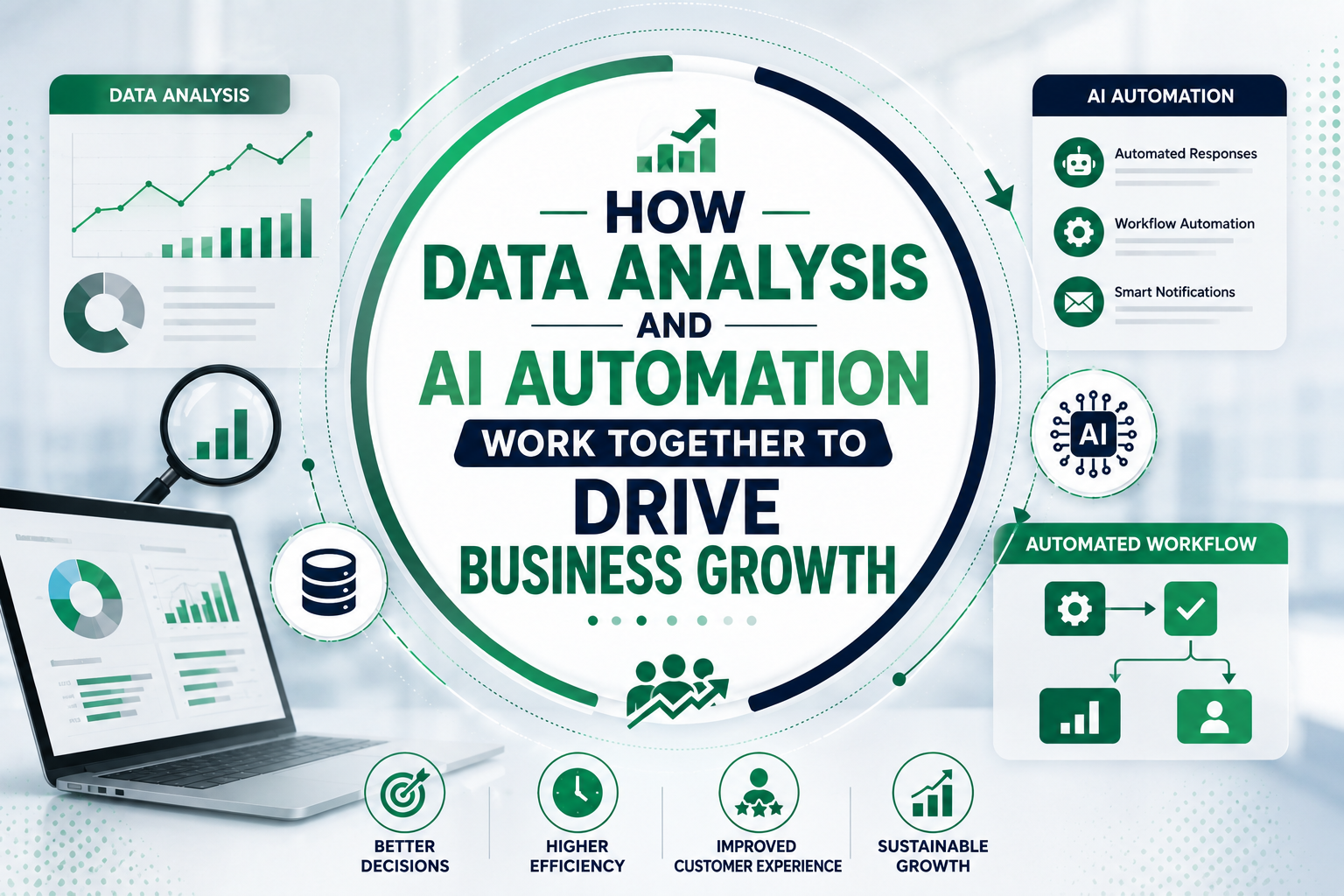
This is where data analysis and AI automation become powerful together. Data analysis helps businesses understand patterns, identify trends, and measure performance. AI automation uses those insights to complete repetitive tasks, trigger actions, and improve workflows automatically. When combined, they help businesses move faster, reduce manual effort, and make smarter decisions.
This combination is no longer only used by large companies. Small businesses, startups, and growing teams are also using data analysis and automation to improve operations and create more efficient systems. From managing inventory to improving customer experience, businesses across industries are using both to drive growth and stay competitive.
The Role of Data Analysis in Business Growth
Data analysis is the process of collecting, cleaning, organizing, and interpreting information to discover useful insights. It helps businesses understand what is happening and why it is happening.
Instead of relying on assumptions, teams can use real numbers to guide business decisions. This creates stronger planning because decisions are based on measurable performance rather than guesswork.
For example, an online retail business may review sales data from the last six months and discover that certain products consistently perform better during weekends. That insight allows the business to adjust advertising budgets and launch promotions during high-performing periods.
A restaurant business may use sales reports to understand which menu items sell most during lunch compared to dinner. With that information, they can prepare ingredients more accurately and reduce waste.
Businesses commonly use data analysis to:
- Monitor revenue and sales performance
- Measure campaign results
- Understand customer behavior
- Identify workflow bottlenecks
- Support business planning and forecasting
The goal is simple: turn raw information into clear insights that support better decisions.
How AI Automation Improves Business Efficiency
AI automation combines artificial intelligence with workflow automation. It helps businesses complete repetitive tasks automatically while using data to make decisions more intelligently.
Traditional automation follows fixed instructions. AI automation can go further by recognizing patterns, adapting to new data, and helping automate more complex workflows.
A simple real-world example is customer support. Many businesses receive similar customer questions every day. AI can recognize the topic of each message, categorize it, and either respond automatically or send it to the correct department.
Finance teams also benefit. Instead of reviewing every invoice manually, AI automation can detect recurring payment patterns, approve standard transactions, and notify staff when something unusual appears.
Examples of AI automation in business include:
- Sending personalized customer follow-ups
- Updating dashboards automatically
- Categorizing support tickets
- Triggering notifications based on performance changes
- Automating recurring reports
- Organizing leads from forms or CRM systems
This helps teams reduce repetitive work and spend more time on strategic priorities.
Why Data Analysis and AI Automation Work Better Together
Data analysis helps businesses understand what is happening. AI automation helps businesses respond immediately.
Used separately, both are valuable. Together, they become much more effective.
Imagine an e-commerce business analyzing customer purchase history. The data shows that customers who buy fitness equipment often return within two weeks to purchase accessories. That insight becomes more powerful when automation sends personalized product recommendations automatically after the first purchase.
A logistics company provides another example. Data analysis may reveal that certain routes experience delays every Monday morning. AI automation can use that information to adjust scheduling or send alerts to drivers before delays happen.
The biggest value comes from creating a faster cycle:
- Data reveals the opportunity
- AI automation responds immediately
- Results are tracked automatically
- New insights improve future actions
This creates continuous improvement with less manual work.
Better Decision-Making With Real-Time Insights
Business decisions often depend on timing. A delayed response can lead to missed opportunities.
Data analysis helps businesses monitor performance continuously. AI automation makes sure those insights reach the right people quickly and can even trigger actions automatically.
For example, a retail business may track daily sales through an automated dashboard. If sales suddenly drop below target, managers receive an alert immediately and can review what changed.
Marketing teams use this in a similar way. If a campaign performance drops, automation can notify the team instantly or pause ad spending based on pre-defined conditions.
Real-time insights are useful for:
- Monitoring sales performance
- Tracking inventory levels
- Measuring customer engagement
- Reviewing campaign performance
- Managing team productivity
Instead of waiting for weekly reporting, businesses can respond faster and stay ahead.
Improving Customer Experience Through Data and Automation
Customer experience has become one of the most important drivers of growth.
Businesses that understand customer behavior and respond quickly often create stronger loyalty and improve retention.
A familiar example is Netflix. The platform analyzes viewing behavior and recommends content based on user preferences. This keeps the experience personalized and increases engagement.
The same strategy works for smaller businesses. A local online store can analyze purchase history and automatically send reminders or recommend related products.
For example:
A customer buys office supplies from an online store. Based on previous buying behavior, the business predicts the customer may need restocking in a few weeks. AI automation sends a reminder at the right time.
That creates benefits for both sides:
- Customers receive relevant communication
- Businesses increase repeat purchases
- Teams reduce manual follow-up work
- The customer experience feels more personalized
Small improvements in customer experience often create stronger long-term growth.
Increasing Operational Efficiency With Smarter Workflows
As businesses grow, internal workflows become more complex.
Tasks like updating spreadsheets, sending recurring reports, checking inventory, or reviewing documents can take hours every week.
Data analysis helps identify which processes are slowing the business down. AI automation helps reduce those delays.
A warehouse business, for example, may review shipping data and notice delays caused by low stock availability. Automation can then trigger restocking alerts or notify staff before inventory reaches a critical level.
Human resources teams also use this approach. They may analyze hiring performance and identify where candidates drop out in the recruitment process. Automation can schedule interviews or send follow-up emails automatically.
These improvements may feel small individually, but together they create stronger productivity and smoother operations.
Supporting Business Growth at Scale
Growth brings more customers, more communication, and more operational demands.
Without efficient systems, scaling becomes difficult because teams spend more time managing repetitive work.
Data analysis helps businesses understand growth patterns and identify what resources are needed. AI automation supports growth by handling repetitive tasks consistently.
For example, an e-commerce business may start with dozens of orders per week. As sales increase, manual order tracking becomes harder.
Automation can help by:
- Confirming orders automatically
- Updating inventory in real time
- Sending customer notifications
- Generating sales summaries
- Tracking order fulfillment progress
This allows businesses to grow without increasing manual workload at the same speed.
Preparing for Future Opportunities With Predictive Insights
One of the biggest advantages of combining data analysis and AI automation is prediction.
Historical business data often reveals patterns that help teams prepare for future opportunities.
A retailer may notice increased demand before holiday seasons every year. With that information, automation can prepare inventory, schedule promotions, and notify teams earlier.
Subscription-based businesses often use predictive insights to reduce customer churn. If usage data suggests a customer may stop using the service, automation can send a retention offer before cancellation happens.
Predictive business actions often include:
- Inventory planning
- Seasonal campaign scheduling
- Customer retention efforts
- Revenue forecasting
- Resource planning
This shifts businesses from reacting late to planning ahead.
Challenges Businesses Should Consider
While the benefits are strong, businesses need the right foundation.
First, data quality matters. Incomplete or inconsistent data leads to weak insights and unreliable automation.
Second, workflows need structure. Automating a confusing process often creates more confusion. Clear systems work best.
Third, teams need adoption. Employees need time to understand how new workflows support their work.
A practical approach is starting small.
Many businesses begin with:
- One dashboard
- One repetitive workflow
- One automation process
Once results are measurable, they expand gradually.
This approach reduces risk and makes implementation easier.
Final Thoughts
Data analysis and AI automation are becoming essential tools for modern business growth.
Data analysis helps businesses understand performance, customer behavior, and operational trends. AI automation transforms those insights into faster workflows and smarter actions.
Together, they help businesses:
- Make better decisions
- Improve customer experience
- Increase operational efficiency
- Scale more effectively
- Prepare for future opportunities
The result is a business that can move faster, reduce repetitive work, and focus more on growth.
As digital transformation continues, businesses that combine data analysis with AI automation effectively will be better positioned to compete and adapt in an increasingly data-driven market.
Need Help Using Data Analysis and AI Automation for Your Business?
If you have business data and want to turn it into meaningful insights while automating repetitive workflows, I’d be happy to help.
Visit kenchristn.com to explore my portfolio and recent projects in data analysis, dashboards, and AI automation.
You can reach out for help with:
- Data cleaning and preparation
- Business dashboard creation and KPI reporting
- SQL analysis and data visualization
- Workflow automation with AI tools
- Automating repetitive reporting tasks
- Turning business data into actionable insights
- Building smarter systems with data analysis and automation
Let’s turn your business data into smarter decisions—and automate the work that helps your business grow.