
Machine Learning
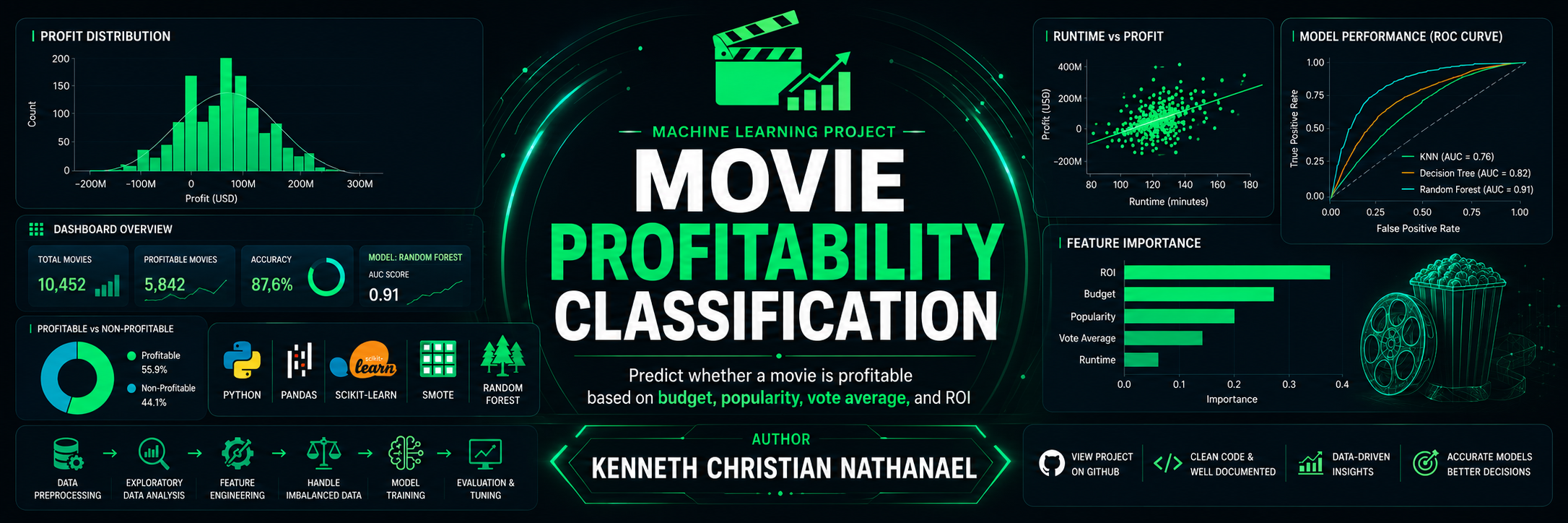
Movie Profitability Classification
Overview
This project builds a machine learning model to predict whether a movie is successful based on financial and popularity features. It covers a complete data science workflow including data preprocessing, feature engineering, handling imbalanced data, model training, evaluation, and hyperparameter tuning.
This project demonstrates a complete machine learning pipeline with a focus on model evaluation beyond accuracy, including ROC-AUC and confusion matrix analysis.
Objectives
- Analyze factors influencing movie success
- Perform data cleaning and feature engineering
- Build and compare multiple classification models
- Improve model performance with hyperparameter tuning
Tech Stack







Dataset
The project uses two datasets:
movies_metadata.csv
Contains detailed information about movies.
Main columns:
id→ Unique movie identifiertitle→ Movie titlebudget→ Production budgetrevenue→ Total revenuepopularity→ Popularity scoreruntime→ Duration of the movie (minutes)vote_average→ Average rating scorevote_count→ Number of votesrelease_date→ Release dategenres→ Movie genres (JSON format)original_language→ Original language
ratings_small.csv
Contains user ratings for movies.
Main columns:
userId→ Unique user identifiermovieId→ Movie identifier (linked to movies dataset)rating→ User rating (scale 0–5)timestamp→ Time of rating submission
Workflow
Data Preprocessing
Data Preprocessing
- Handle missing values to maintain data consistency.
- Convert data types into appropriate formats for analysis.
- Create new features including Profit and ROI (Return on Investment).
- Apply log transformations to improve data distribution and reduce skewness.
h
Exploratory Data Analysis (EDA)
Exploratory Data Analysis (EDA)
- Analyze profit distribution to understand overall performance trends.
- Detect outliers and extreme values in the dataset.
- Explore the relationship between runtime and profit.
- Identify key patterns and insights before model development.
h
Feature Engineering
Feature Engineering
- Select key features including Budget, Popularity, Vote Average, and ROI.
- Create log_profit to reduce skewness in profit values.
- Create log_budget to normalize budget scale.
- Create log_popularity to stabilize variance.
- Improve model performance by reducing the impact of outliers.
h
Handling Imbalanced Data
Handling Imbalanced Data
- Perform feature scaling before balancing.
- Apply SMOTE (Synthetic Minority Oversampling Technique).
- Balance minority and majority target classes.
- Reduce bias and improve model learning.
h
Model Training
Model Training
- Train K-Nearest Neighbors (KNN) model.
- Train Decision Tree model.
- Train Random Forest model.
- Compare model performance and reliability.
h
Evaluation Metrics
Evaluation Metrics
- Measure Accuracy, Precision, Recall, and F1-score.
- Analyze Confusion Matrix.
- Evaluate ROC-AUC Score.
- Visualize performance with ROC Curve.
h
Hyperparameter Tuning
Hyperparameter Tuning
- Use GridSearchCV for model optimization.
- Test multiple Random Forest parameter combinations.
- Select the best-performing model configuration.
- Improve prediction accuracy and consistency.
h
Model Performance
| Model | Accuracy | ROC-AUC |
| KNN | 0.62 | 0.53 |
| Decision Tree ★ | 0.77 | 0.52 |
| Random Forest | 0.77 | 0.54 |
| Random Forest (Tuned) | 0.77 | 0.52 |
Confusion Matrix (Final Model)
[ 1  5]
[ 4 29]
Interpretation:
- Model performs well in predicting successful movies (True Positive)
- Struggles to correctly identify unsuccessful movies
- High False Positives → model tends to classify movies as successful
ROC Curve Analysis
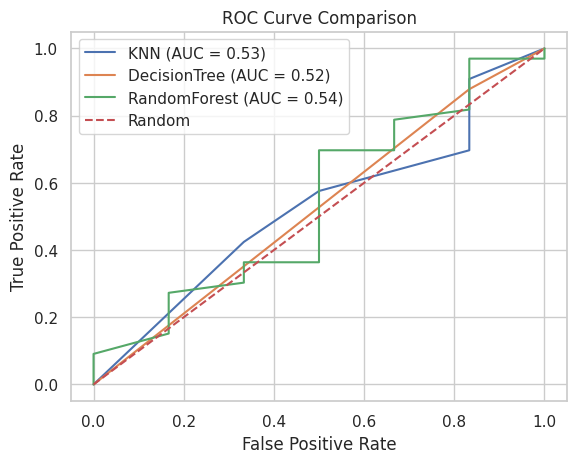
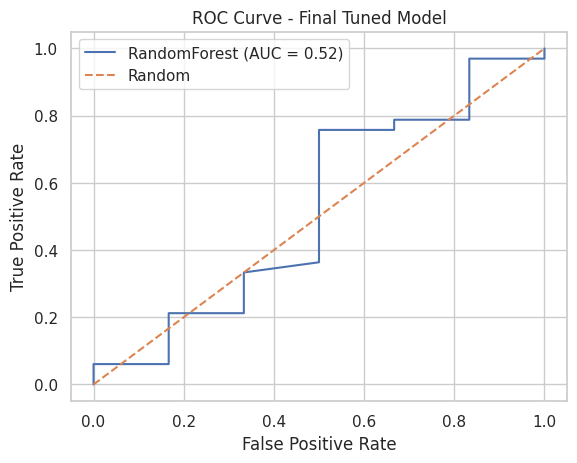
- ROC-AUC scores are relatively low (~0.52–0.54)
- Indicates model performance is only slightly better than random guessing
- Suggests that Features are not strongly discriminative and Dataset is highly imbalanced
Key Insights
- High budget does not guarantee success
- Popularity is a strong predictor of movie performance
- ROI provides better signal than raw financial metrics
- Accuracy alone can be misleading → ROC-AUC gives deeper insight
Future Improvements
- Improve feature selection
- Try advanced models (XGBoost, LightGBM)
- Optimize classification threshold
- Use cross-validation for all models
- Deploy model as API or dashboard